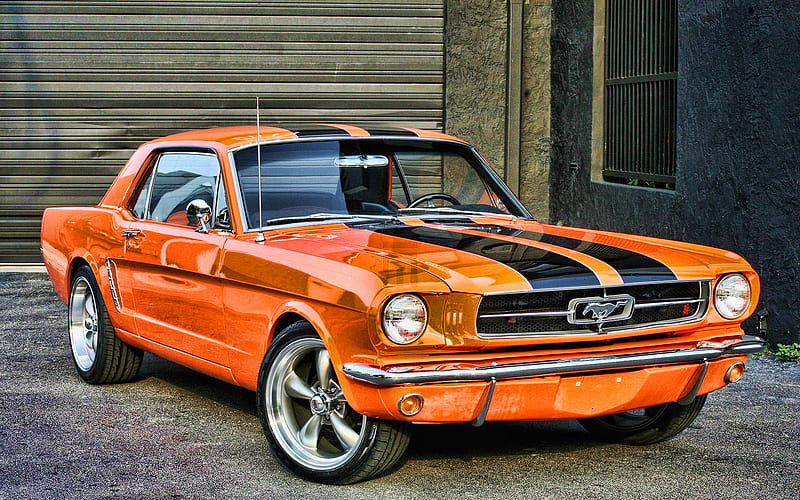
The First-Generation Ford Mustang (1964–1973)
The first-generation Ford Mustang, produced from March 1964 through 1973, wasn’t just a new car—it was a movement. Its introduction created an entirely new segment in the American auto industry: the pony car. Defined by its sporty styling, affordability, and performance options, the Mustang quickly became a cultural phenomenon.
A Bold Beginning
Unveiled on April 17, 1964, at the New York World’s Fair, the Mustang made an immediate impact. Originally offered as a hardtop and convertible, the fastback joined the lineup in August 1964. Though based on the compact Ford Falcon platform, the Mustang featured entirely new styling that turned heads and opened wallets. Ford sold over 22,000 Mustangs on the first day alone.
Design and Innovation
The Mustang’s development was rapid and intensely collaborative. Chief Engineer Donald N. Frey led the project, and Ford executive Lee Iacocca backed it with enthusiasm. The final design—produced under Joe Oros, with input from L. David Ash, Gale Halderman, and others—blended American muscle with European elegance.
Design goals were ambitious: the car had to seat four, weigh under 2,500 pounds, cost less than $2,500, and be highly customizable. Key design features included:
- Long hood and short deck proportions
- Sculpted side scoops and a fastback roofline (in later versions)
- Innovative “torque box” structure for enhanced rigidity
- Floating bumpers and unique front-end styling
The Mustang was sporty yet practical, powerful yet affordable—an irresistible formula for the American public.
Performance and Evolution
Mustang buyers could choose from a wide range of options, from a basic inline-six to powerful V8 engines. Each revision brought more performance and a larger body. The 1971 redesign was the most radical, with a longer, wider, and heavier frame. By the end of its first generation in 1973, however, sales had begun to decline due to rising fuel prices and changing market preferences.
Anticipating the oil crisis, Ford had already designed the Mustang II—a smaller, more economical successor that debuted in 1974.
Pros and Cons of the First-Generation Mustang
✅ Pros
- Timeless styling: Classic design that remains iconic even today
- Customizability: Wide range of engines, trims, and interior/exterior options
- Affordability: Originally priced for the average consumer
- Strong enthusiast support: Parts and restoration help are readily available
- Fun to drive: Especially V8 models, offering satisfying power and sound
❌ Cons
- Outdated safety features: Lacks airbags, crumple zones, and modern crash protection
- Handling limitations: Basic suspension and steering feel unrefined by today’s standards
- Fuel efficiency: Poor by modern metrics, especially for V8 models
- Build quality inconsistencies: Common in early mass-produced models
- Rust issues: Common problem with original chassis and body panels
Classic vs. Modern: Comparing the First-Gen Mustang to Today’s Models
| Feature | 1964–1973 Mustang | Modern Mustang (e.g., 2025 GT) |
| Performance | Up to 375 hp (Boss 429) | 480–800+ hp (GT, Mach 1, Dark Horse, GTD) |
| Transmission | 3- or 4-speed manual, auto | 6-speed manual, 10-speed automatic |
| Safety | Basic belts, no airbags | ABS, traction control, multiple airbags, lane assist |
| Fuel Economy | 10–18 mpg (approx.) | 19–26 mpg (depending on engine) |
| Technology | AM radio, basic gauges | Touchscreen, digital cockpit, Apple CarPlay, drive modes |
| Comfort | Basic bucket seats | Heated/cooled leather, adaptive suspension |
| Build Quality | Steel frame, prone to rust | Modern materials, galvanized panels, corrosion protection |
| Driving Feel | Raw and mechanical | Balanced, refined, high-tech |
While today’s Mustangs are objectively better in terms of performance, safety, and technology, the original offers a visceral, analog driving experience that modern cars often lack. It’s not just about speed—it’s about style, attitude, and legacy.
Final Thoughts
The first-generation Ford Mustang didn’t just change the car market—it changed culture. It was fast, affordable, stylish, and accessible to nearly anyone. Though today’s Mustangs are faster and more advanced, the original still holds a special place in automotive history and continues to inspire enthusiasts, collectors, and manufacturers alike.
Whether you admire it for its heritage or its head-turning design, the first-gen Mustang remains one of the most beloved American cars ever made.